
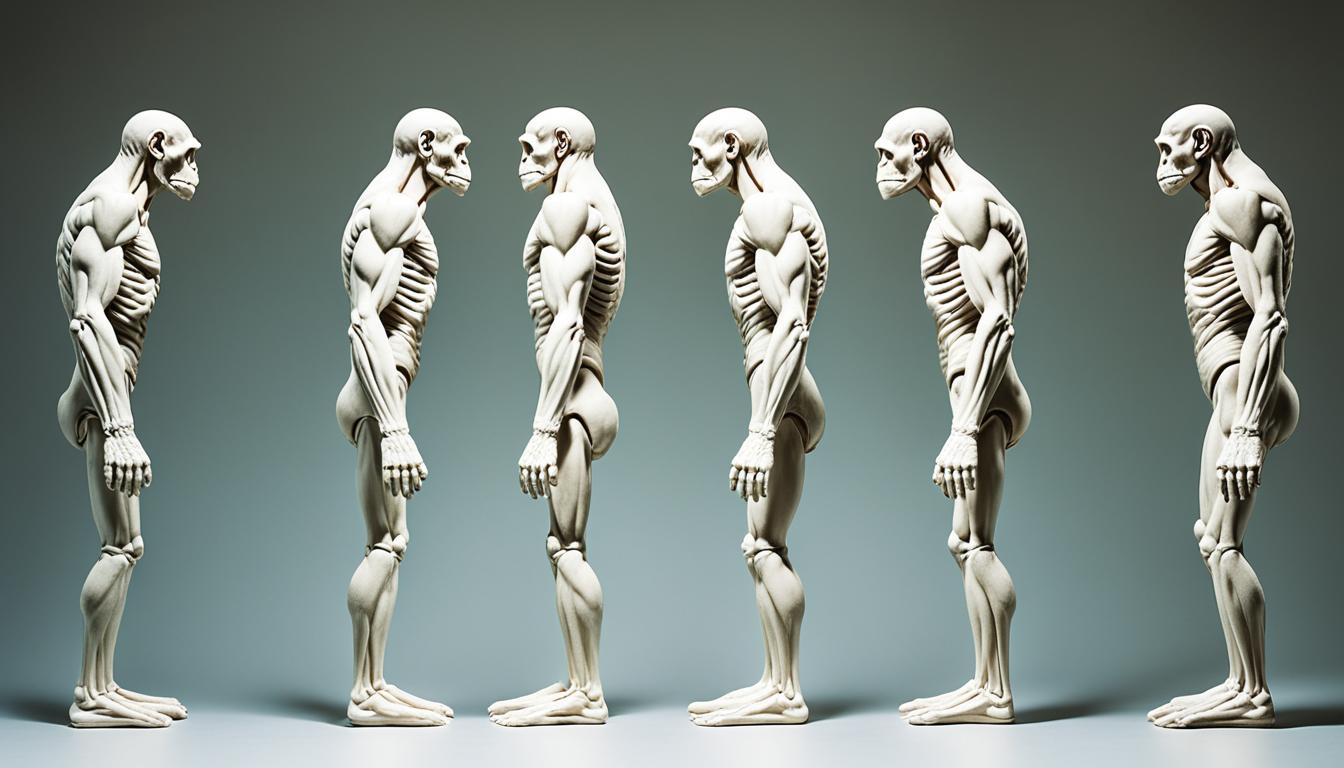
Get ready to be amazed by 10 fascinating facts about our species’ evolution. We’ll explore how our ancient ancestors moved and how our brains developed. Join us on an exciting journey to see how humans became who we are today.
Did you know early humans like Homo erectus first left Africa and spread worldwide? They moved due to climate changes and the search for food. This set the stage for the diverse populations we have today.
Another cool fact is how humans learned to walk on two legs. This ability, unique to us, changed our species in big ways. It affected our bones and how we interact with the world.
Our ancestors’ brains got bigger and more complex over time. This led to amazing cognitive abilities. These skills helped us make the cultural and tech advances we see today. Scientists are still studying this brain evolution, finding it very interesting.
Get ready for 10 amazing facts that show the incredible story of human evolution. Be amazed by our species’ resilience, adaptability, and creativity.
Uncovering Our Ancestral Origins
Exploring human evolution is a fascinating journey that goes back millions of years. It shows us the many early human species that lived on Earth. These ancient beings, with their special traits and ways of moving, have shaped our genes. They give us clues about where we come from.
Early Human Species and Their Migrations
Species like the strong Homo erectus and the mysterious Neanderthals had unique traits. These helped them survive in different places. As they moved around the world, they faced new challenges and chances. This shaped our evolution.
By looking at fossils and genetic clues, scientists are learning about our ancestors’ moves. They’re creating a detailed picture of how humans spread out.
Tracing the Genetic Footprints of Our Ancestors
Genetic studies have changed how we see human evolution. By looking at our DNA and comparing it to ancient samples, scientists learn about our genetic history. This helps us understand how different groups of people are related and how they moved.
This genetic mapping is a key tool for seeing how early humans connected and mixed. It shows the rich diversity of genes we have today.
Fun Facts About Human Evolution
Explore the fascinating world of human evolution and discover amazing facts. From surprising adaptations to interesting behaviors, these facts will make you see our ancient past in a new light.
The earliest human-like creatures, the Australopithecines, had brains as big as modern chimpanzees. Yet, they could use simple stone tools. This shows how our thinking skills slowly got better over millions of years.
Did you know our ancient cousins, the Neanderthals, had bigger brains than us? But having a bigger brain didn’t mean they were smarter. They were eventually replaced by Homo sapiens, who were more adaptable.
It’s also surprising that humans can digest lactose as adults, a skill that’s not natural for many animals. This ability started in some groups about 10,000 years ago, with the rise of dairy farming.
These fun facts about human evolution are not just interesting. They help us understand how diverse and strong our species is. By looking into these facts, we can appreciate the incredible path that brought us to where we are today.
The Power of Bipedalism
Bipedalism, or walking on two legs, is a key trait of our species. It makes us different from our primate ancestors. This ability has greatly influenced our evolution, affecting both our body and mind.
How Walking on Two Legs Shaped Our Species
Switching to bipedalism led to big changes in our body. Our spine, pelvis, and lower limbs changed. These changes made us better at walking and freed our hands for tools.
This allowed us to use tools and develop new technologies. It also boosted our brain power. Bipedalism changed how we use energy and keep cool, letting us travel far and live in different places.
This helped humans spread out and grow into different groups. It helped us take over new lands. Bipedalism was a big step in human evolution. It led to our amazing growth and diversity over millions of years.
Brain Development and Intelligence
The human brain is an amazing organ that has grown over millions of years. It has become bigger and more complex to support our intelligence and thinking skills. This shows how adaptable and resilient our species is.
When our early human ancestors started walking upright, they needed a smarter brain. This led to the growth of the cerebral cortex. This part of the brain is key for thinking deeply, solving problems, and speaking. It made us stand out from other animals.
Studies in neuroscience have uncovered important steps in the brain’s evolution. Areas like the prefrontal cortex and the temporal lobe have developed. They help us make decisions, control our impulses, remember things, and speak. These changes have helped us become smarter and more social.
Adapting to Changing Environments
Humans have always had to adjust to a world that keeps changing. We’ve faced many environmental challenges and changes over time. From big ice ages to slow climate shifts, our ancestors found new ways to survive.
Climate Change and Its Impact on Human Evolution
Climate change has greatly affected human evolution. As the Earth’s weather changed, our ancestors had to adapt to stay alive. For example, when it got colder during ice ages, they grew bigger and got more body fat to keep warm.
Changes in the weather and plants also made them change how they found food. This led to better tools and eating more kinds of food. These changes helped shape who we are today, affecting our bones and how we think.
Looking at how our ancestors adapted teaches us about our species’ strength and creativity. It helps us understand our past and how we might deal with climate change today.
Cultural and Technological Advancements
The journey of human culture and technology shows our species’ creativity and flexibility. From the first stone tools to today’s advanced tech, our tool and technology evolution has pushed our culture forward.
From Stone Tools to Modern Innovations
Early humans started with simple stone tools to hunt, process food, and protect themselves. These tools got more complex over time, showing how our societies grew and needed specialized tools for different tasks.
As our culture grew, so did our technology. Discoveries like fire, the wheel, and other key innovations helped us improve in transportation, farming, and communication. These advances made life better and helped us develop new tools and technology.

From ancient stone tools to today’s tech like computers and smartphones, we’ve shown our ability to innovate and solve problems. Each step has shaped our culture and society, leading us to our advanced civilization today.
Dietary Shifts and Their Consequences
The way our diet has changed has deeply affected our species. Our ancestors moved from hunting and gathering to farming and modern food systems. This change in diet has shaped our health, body, and social life.
Our diet has changed a lot since the early days of hunting and foraging. We now eat more starch and calories than before. This change has both good and bad effects on our health, affecting our teeth, gut, and the spread of diseases.
As our ancestors changed their living environments, so did their diets. Eating dairy, domesticating animals, and growing grains changed our genes. This helped us to digest these new foods better.
Learning about how our diet has changed and how it affects us is key to understanding our health. By looking at these changes, we can see how our bodies have adapted to today’s world.
The Role of Social Behavior
Human evolution isn’t just about physical changes. It also includes the growth of our social behaviors. Cooperation, language, and forming communities were key in shaping our species. These elements show how social behavior has influenced our unique traits.
Cooperation, Language, and Community Formation
Cooperation is a big part of human evolution. It helped our ancestors succeed in different environments. They formed communities to share resources and support each other, which improved their survival chances.
Language evolution was crucial. It let us share ideas, work together, and pass on knowledge. Language helped us build strong social networks and a common culture. This mix of cooperation, language, and community changed human history.
Looking into social behavior in evolution reveals how we’ve adapted and innovated. Our ability to cooperate, communicate, and form communities has shaped our journey. This helps us value our social connections and the human experience.
Human Diversity and Adaptation
The human species is incredibly diverse, adapting to many environments and climates worldwide. This shows how resilient and adaptable we are, thanks to thousands of years of evolution.
Humans live in places from Africa’s deserts to the Arctic’s frozen lands. They’ve developed unique traits to survive. For example, people in the Himalayas have bigger lungs and more red blood cells to handle the low oxygen.

In the tropics, people have darker skin to protect against strong UV rays. In cold areas, they have more body fat and shorter limbs to stay warm. These adaptations have led to many cultures, languages, and traditions across the globe.
Exploring human genetic diversity tells a story of constant adaptation to our environments. It shows us the resilience and creativity of the human spirit. By learning about this, we can better understand our ability to overcome challenges.
Unraveling the Mysteries of Human Evolution
The search to learn about our beginnings is thrilling and always changing. Scientists worldwide lead the way in human evolution studies. They make new finds that help us understand our complex history.
Ongoing Research and Future Discoveries
Advances in genetics, paleontology, and archaeology help scientists study human evolution. They use ancient DNA, fossils, and artifacts to learn about our ancestors. This helps us see how our evolution was influenced by the environment and behavior.
New technologies and teamwork are set to bring more exciting discoveries. Things like advanced imaging, complex computer models, and combining different sciences will help solve the mysteries of our origins.
Every new find makes us understand human evolution better. We learn about our ancestors’ travels and the genetic changes that let us live in different places. The study of human evolution will continue to amaze and teach us for a long time.
Embracing Our Evolutionary Journey
Exploring human evolution gives us deep insights and lessons. It shows us how we’ve changed over millions of years. This helps us appreciate our strength, ability to adapt, and our great potential.
Learning about understanding human evolution takes us back in time. It shows us how we’ve adapted, moved, and advanced culturally. This knowledge helps us understand our history and guides us in making smart choices for the future.
By valuing our appreciating human evolution, we see how our ancestors overcame tough challenges. They adapted to different environments. Recognizing the importance of studying human evolution helps us respect all life and our duty to protect the world that shaped us.