
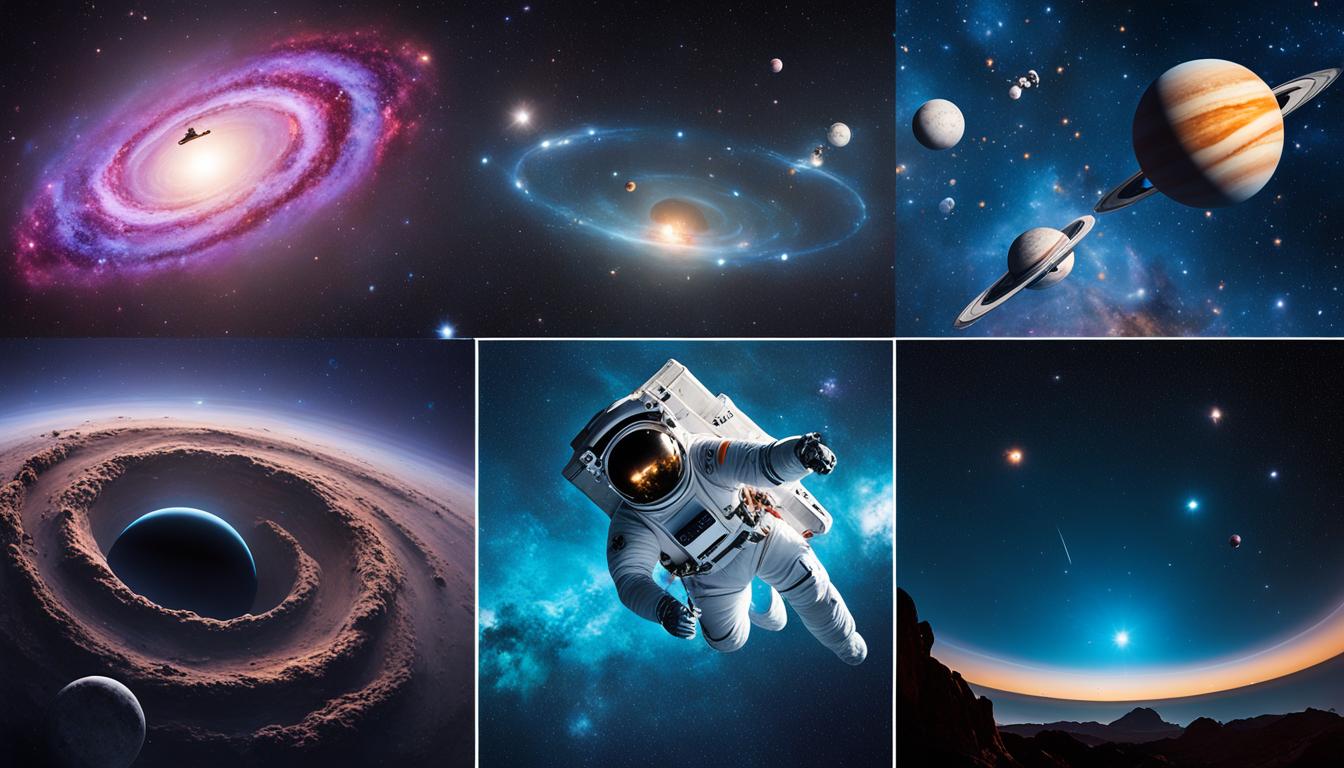
Get ready to be amazed with 10 fun facts about space and astronomy. These facts will broaden your knowledge of the cosmos. You’ll learn about the dance of galaxies and how stardust makes up our existence. This article is a journey through the universe’s wonders.
Space and astronomy are full of fascinating phenomena that push our understanding of the universe. Let’s explore intriguing facts together. They will spark your curiosity and make you appreciate the stars and planets around us.
The Universe’s Cosmic Dance
Galaxies move in a beautiful dance across the universe. This dance is part of the universe’s expansion. It shapes our universe’s structure.
Galaxies in Graceful Motion
Galaxies move in a beautiful way. They rotate, collide, and sometimes merge. This shows the universe’s dynamic nature.
Gravity makes them dance together. This dance is beyond anything we can imagine.
The Expanding Cosmos
The universe is always getting bigger. This affects how galaxies move and where they go. The universe’s expansion makes galaxies move in a special way.
Learning about this expansion helps us understand the universe better. It’s key to figuring out how galaxies move.
Stardust: We Are Made of Stars
Have you ever thought about the amazing fact that our bodies are made of atoms from stars? These atoms were created in the stars’ hearts. They connect us to the universe’s cycle of life. This shows how our universe is a complex web.
The atoms in our bones, muscles, and the air we breathe came from old stars. These stars died in big explosions, sending life-building atoms across the universe. This is called stellar nucleosynthesis. It’s how our existence is linked to star matter.
Our bodies show our cosmic origins. Elements like carbon, oxygen, and nitrogen, vital for life, were made in star reactions. When stars died, they spread these elements, helping form our solar system and planets.
This cosmic dance shows our deep connection to the universe. We’re not just Earth’s people; we’re part of the universe’s cycle. Stardust is more than a figure of speech; it’s true about our makeup, linking us to the vast cosmos.
Fun Facts About the Milky Way
The Milky Way, our home in space, is a wonder that has amazed people for ages. It’s the galaxy that holds our solar system. It’s full of interesting facts that show how big and complex the universe is.
Our Galactic Home
The Milky Way is a spiral galaxy that stretches 100,000 light-years wide. It has between 100 to 400 billion stars. The beautiful spiral arms we see at night are just a small part of it.
Our solar system, including Earth, is about 25,000 to 28,000 light-years away from the center of the Milky Way.
A Supermassive Black Hole’s Reign
At the Milky Way’s center is a supermassive black hole named Sagittarius A*. It’s as massive as 4 million suns and pulls on the area around it strongly. This black hole shows us the huge forces that shape our galaxy.

Learning more about the Milky Way and its supermassive black hole helps us understand and value our place in the universe.
The Enigmatic Dark Matter
The universe is full of mysteries, and dark matter is one of the biggest puzzles. This invisible stuff makes up most of the universe but we can’t see it. Yet, it’s key to understanding how the universe is put together.
An Invisible Cosmic Architect
Dark matter’s gravity shapes the universe in ways we can’t see. It helps create galaxies, galaxy clusters, and cosmic filaments. This invisible force moves stars and galaxies, making the universe what it is today.
Scientists are deeply interested in dark matter’s role in the universe. Its effects on space and time, as Einstein predicted, hint at its nature. New research and better tools help us learn more about this mysterious force.
Exoplanets: Worlds Beyond Our Solar System
In the vast universe, a world of discovery awaits us – exoplanets. These planets orbit stars outside our solar system. They show us the amazing variety of planetary systems. Research on exoplanets is helping us learn how planets form and if there could be life elsewhere.
Astronomers have found thousands of confirmed exoplanets. Each one is a unique and fascinating world. From very hot Jupiters to icy super-Earths, these planets are amazing. They come in many sizes, types, and orbits, changing what we think a planet can be.
Studying exoplanets is more than just listing them. It’s about learning about how planets form and change over time. By looking at exoplanets, scientists learn about the processes that shape planets. This knowledge helps us understand our own Solar System and if there could be life elsewhere.
The study of exoplanets is getting more exciting as we find new and amazing worlds. Finding Earth-like planets and exploring their habitable zones is thrilling. This quest to learn about planetary systems is a key part of modern astronomy.
Fun Facts About Shooting Stars
Have you ever looked up at the night sky and seen a bright streak across the darkness? These are called shooting stars, or meteors. They seem like stars falling, but they tell us about our universe’s dynamic nature.
Celestial Fireworks
Shooting stars aren’t stars. They are tiny pieces of debris, like a grain of sand, entering Earth’s atmosphere fast. As they move through the air, they create a bright trail that lasts a few seconds. This makes a beautiful display of celestial fireworks.
A “meteor shower” happens when Earth goes through a stream of debris, making more shooting stars visible. These showers are linked to certain comets, as the debris comes from their paths.

Most meteors burn up in the atmosphere, but bigger ones can make it to the ground as meteorites. These rare visitors help scientists learn about our solar system. They give insights into how planets and other bodies formed and changed over time.
The Moon’s Celestial Rhythms
The moon is our celestial friend, playing a big role in our planet’s rhythms. It affects everything from the moon’s phases to the tides. Let’s explore the amazing facts about this mysterious moon and how it impacts life on Earth.
Tidal Tales and Lunar Phases
The moon’s gravity makes the tides rise and fall along our shores. As it moves around Earth, it pulls on the ocean, creating high and low tides. This has a big effect on sea life, beach environments, and human activities like fishing.
The moon’s phases, from new to full moon, are a beautiful sight. The part of the moon we see changes, showing us the cycle of waxing and waning. These phases have been important in many cultures, affecting farming, religious events, and our feelings.
The moon’s rhythms show how connected our universe is. By learning about the moon’s effects on Earth, we appreciate the balance that supports life. The moon’s dance in the sky reminds us of the magic above us.
Solar Storms: Nature’s Light Shows
Our skies often light up with cosmic light shows, thanks to the Sun. These solar storms are powerful eruptions from our star. They create beautiful auroras that fill the night with colors like green, purple, and red.
Solar storms happen when the Sun’s magnetic field gets unstable. This leads to bursts of charged particles and solar radiation into space. When these particles meet Earth’s magnetic field, they cause the amazing lights we see in the sky.
But solar storms aren’t just pretty to look at. They can mess with our technology, like communication systems, GPS, and even the power grid. It’s important to watch out for these events to protect our modern life.
People all over the world look forward to seeing the lights in the sky caused by solar storms. These events remind us of how dynamic and changing our solar system is. They show us the Sun’s big role in our world.
Cosmic Curiosities: Pulsars and Quasars
Explore the fascinating world of pulsars and quasars, two mysterious and powerful cosmic phenomena. They help us understand extreme spaces and the secrets beyond our planet.
The Universe’s Celestial Beacons
Pulsars are the fast-spinning leftovers of huge stars. They act like cosmic lighthouses, sending out strong beams of radiation across the sky. These stars help scientists learn about gravity, matter, and extreme cosmic conditions.
Quasars are the bright centers of far-off galaxies, powered by supermassive black holes. They give us a peek into the early universe. This helps us understand how it evolved and formed the biggest structures in space.
Studying pulsars and quasars reveals new things about the universe. It shows us how matter behaves under extreme conditions and how the cosmos began and changed over time. As we delve deeper into these mysteries, we’re amazed by the universe’s endless wonders.
The Mysteries of Black Holes
Step into the world of black holes, the most mysterious and powerful things in space. These cosmic puzzles challenge our grasp of physics, pushing us to learn more. They show us how gravity can warp space and time in ways we can’t imagine.
At the center of a black hole is a singularity, where matter is incredibly dense and space-time is severely curved. This spot pulls everything towards it, even the fastest things, including light. Looking into black holes helps us understand our universe better.
Let’s uncover the secrets of black holes by looking at their unique features. We’ll see the latest research on these cosmic wonders. Join us as we explore the mysteries they hold about our universe’s forces.