
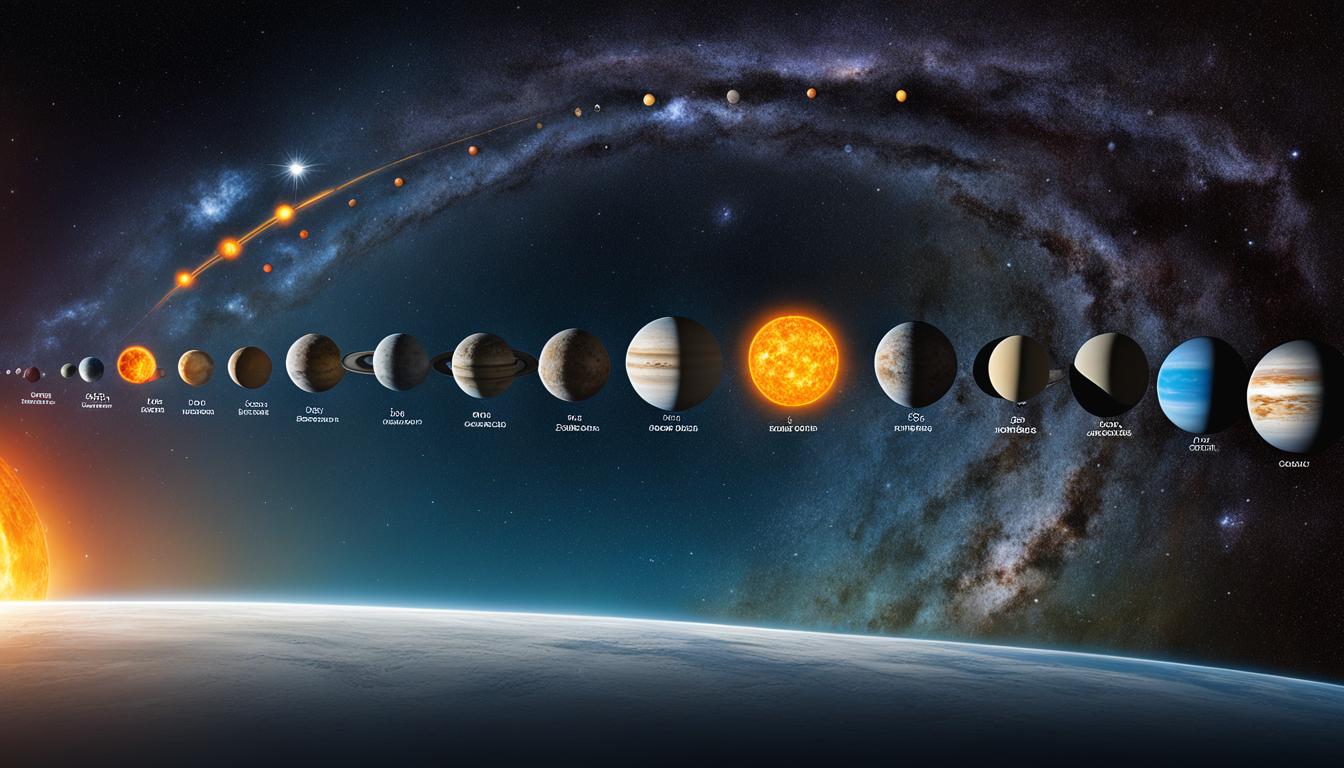
Get ready for an exciting journey through our solar system. We’ll explore 10 amazing facts that will leave you starry-eyed. From the huge size of our home in space to the sun’s intense heat, and the stunning beauty of the planets, you’ll be amazed.
Learn about the mysteries of dwarf planets, moons, and the unknown dark matter and dark energy. Prepare to be amazed by the wonders of our solar system.
The Staggering Size of the Solar System
The size of our solar system is truly awe-inspiring. At its core is the sun, a massive star that makes up over 99% of the solar system’s mass. The eight major planets orbit the sun, each with its own unique features and distance from the center.
The scale of the solar system is huge. The distance from the sun to the edge of the solar system, called the heliopause, is about 93 billion miles (150 billion km). This distance is so big it’s hard to imagine. A commercial airplane flying at its fastest speed would take over 1 million years to reach the edge of our cosmic neighborhood.
Exploring the Vastness of Our Cosmic Neighborhood
The size of the solar system shows how huge the universe is. The planets orbit the sun at distances from 36 million miles (Mercury) to 3.7 billion miles (Neptune). The vastness of the solar system reminds us of our small place in the universe.
As we explore and study the solar system, we learn more about its huge scale and the forces that shape it. This knowledge satisfies our curiosity and inspires wonder. It helps us appreciate the incredible mysteries in our cosmic neighborhood.
The Scorching Heat of the Sun
At the center of our solar system is the sun, a huge ball of plasma that creates a lot of energy. The sun’s surface is incredibly hot, at 10,000 degrees Fahrenheit (5,500 degrees Celsius). But things get even hotter at the core, reaching a staggering 27 million degrees Fahrenheit (15 million degrees Celsius).
This intense heat is what makes the sun work. It powers the sun’s nuclear fusion reactions. These reactions are what give us light and warmth, making life on Earth possible. The sun’s core sends out heat that shapes our solar system. It’s key to understanding how our cosmic neighborhood works.
The sun’s core is the hottest part of our star. It shows the amazing power at the heart of our solar system. The heat from the sun’s core, thanks to nuclear fusion, keeps our planet and others moving. It brings us the warmth and light we need to live.
Fun Facts: Surprising Trivia About Our Celestial Neighbors
The planets in our solar system are truly fascinating, each with its own unique quirks. Did you know Venus rotates backwards compared to most other planets? Or that Saturn’s rings are made up of billions of pieces of ice and rock? And let’s not forget Uranus’s tilt, which makes it stand out from the rest.
These are just a few of the captivating facts about our solar system. Discover more interesting tidbits that show the wonders of our cosmic neighborhood. From the Sun’s scorching heat to the beauty of the planets, there’s always something new to learn.

So, dive in and explore the surprising details that make our solar system unique. Whether you’re an astronomy expert or just curious, these fun facts will interest you. They’ll also help you understand the planets better, making our cosmic home even more extraordinary.
The Mesmerizing Beauty of the Planets
In our solar system, the planets are like stars that catch our eye. They show off their unique beauty with planet colors and planet patterns. These sights are a treat for anyone who looks at them.
Neptune stands out with its bright blue color and moving clouds. Mars has a reddish look that seems from another world. Each planet has its own special beauty of planets. They show a mix of colors and textures that amaze us.
A Kaleidoscope of Colors and Patterns
Saturn’s rings and Uranus and Neptune’s stripes are eye-catching. Jupiter’s Great Red Spot, a huge storm, shows how planets change. These sights are a wonder to see.
Looking at the planet patterns and planet colors is an adventure. It lets us see the beauty and complexity of our planets. Whether we look at the stars or through a telescope, the beauty of planets always moves us.
The Enigmatic Dwarf Planets
There’s more to our solar system than the eight major planets. Dwarf planets are fascinating and capture the interest of astronomers and space fans. Pluto, once seen as the ninth planet, was reclassified as a dwarf planet in 2006. This change showed us the complexity of our solar system.
Pluto isn’t the only small world that interests us. Ceres, the biggest object in the asteroid belt, is also a dwarf planet. Eris, bigger than Pluto, adds to the mystery of these small celestial bodies.
Dwarf planets make us wonder about our solar system’s creation and evolution. Their study helps us learn more, challenging our current understanding of the universe. By exploring these mysterious worlds, we discover new things that deepen our knowledge and spark our curiosity about the universe.
The Cosmic Dance of the Moons
Our solar system is filled with moons, each one special in its own way. Earth’s moon came to be when a huge object hit the young Earth. It helps control our planet’s tides and keeps it stable.
Jupiter and Saturn, the gas giants, have many moons. Jupiter has 79, and Saturn has 82. Saturn’s moon Titan is unique because it has a thick atmosphere. Learning about these moons helps us understand how planets formed and changed over time.
Uncovering the Secrets of Earth’s Natural Satellites
The Earth’s moon has always fascinated us. Scientists are still learning about its effects on our planet. It helps keep our planet stable and affects the tides. By studying moons, we learn more about our solar system’s history.

The Mysterious Asteroid Belt
The asteroid belt sits between Mars and Jupiter. It’s filled with millions of rocky objects, from tiny pebbles to huge rocks. These asteroids tell us about the early days of our solar system.
Most asteroids are harmless, but big ones can be dangerous. One asteroid might have caused the dinosaurs to go extinct. Scientists are studying the asteroid belt to learn more about these objects and their risks.
The belt also has dwarf planets like Ceres, which was once thought to be a full planet. These dwarf planets and asteroids help us understand how our solar system formed. They show us the early stages of planet creation.
Exploring the asteroid belt will reveal more about our solar system’s history. It will also show the amazing variety of objects out there. The asteroid belt’s secrets will continue to amaze scientists and space fans for a long time.
The Cosmic Fireworks of Meteors and Comets
Beyond the planets and their moons, our solar system has many amazing objects. Meteors, or shooting stars, are small pieces of debris burning up as they enter Earth’s atmosphere. They create a brief streak of light in the night sky. Comets are icy bodies from the outer solar system. They develop spectacular tails as they get closer to the sun.
Streaking Across the Night Sky
These cosmic fireworks are a treat for skywatchers. Meteor showers happen when Earth goes through the debris trails left by comets. This lets us see many meteors streaking across the sky. Studying these events helps us learn about our solar system’s composition and evolution.
The brief glow of a meteor or the majestic arc of a comet’s tail always amazes us. As we look up, we’re reminded of the wonders beyond our planet. These mysteries continue to capture our imagination.
The Enigmatic Dark Matter and Dark Energy
There’s more to our universe than what we can see. Dark matter and dark energy are mysteries that make up most of the universe. They are still unknown to us, despite their big presence.
Dark matter pulls on galaxies and helps shape the universe. Dark energy pushes the universe apart, which is hard to understand with our current knowledge.
Scientists are deeply interested in solving these mysteries. Finding out about dark matter and dark energy could change how we see the universe. This challenge is at the heart of modern astronomy and cosmology.